
Close
Incoterms is short for International Commercial Terms. The terms were created in 1936 by the International Chamber of Commerce (ICC) to simplify communication problems in international negotiations. They also bring together standardized rules that cover the whole international trade chain.
Over the years, as trade between different countries grew, Incoterms gained strength. Today they are the main reference for defining the agreement between buyer and seller, as well as their obligations when purchasing goods.
If you want to learn more about the terms and the specifics of each acronym, read on:
Incoterms define the rights and obligations between importer and exporter. Through the chosen term, the responsibilities and duties during the negotiation of a product or goods are established.
✔️ Establish where the exporter must hand over the product or goods;
✔️ Define who pays for international freight up to arrival in the destination country;
✔️ Define who is responsible for export and import formalities and their costs;
✔️ Define who takes out insurance on the goods;
✔️ Establish the limits of each party’s risks (buyer and seller);
It is worth stressing that Incoterms exist to provide better dialogue between those who buy and those who sell goods, making negotiation easier and, as a result, helping trade expand.
Moreover, more than defining the obligations between importers and exporters, Incoterms mark where the supplier’s obligations end and where the importer’s responsibilities begin.
Every 10 years, the terms are reviewed and undergo small changes. The latest version was released globally in 2019 and has been in force since January 2020. In total, 11 acronyms make up the current table of international trade terms.
According to the ICC, the Incoterms 2020 rules are:
EXW — Ex Works (named place of delivery);
FCA — Free Carrier (named place of delivery);
FAS — Free Alongside Ship (named port of shipment);
FOB — Free On Board (named port of shipment);
CPT — Carriage Paid To (named place of destination);
CIP — Carriage And Insurance Paid To (named place of destination);
CFR — Cost And Freight (named port of destination);
CIF — Cost, Insurance And Freight (named port of destination);
DAP — Delivered At Place (named place of destination);
DPU — Delivered At Place Unloaded (named place of destination); and
DDP — Delivered Duty Paid (named place of destination).
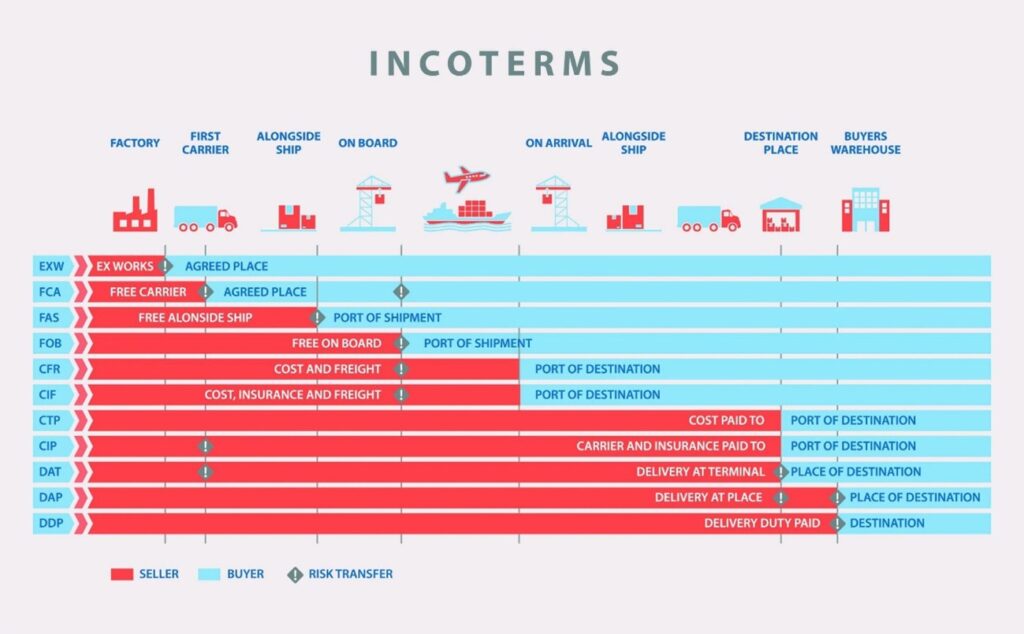
Each Incoterm has characteristics and specifications needed to summarize, in legal terms, the negotiation between buyer and supplier.
For each mode of transport (sea, air, road or rail), there is a group of terms that meets the needs and demands of international freight.
International Commercial Terms (Incoterms) as set out by the International Chamber of Commerce (ICC) in its Publication No. 723-E, 2020:
EX WORKS (named place of delivery)
The seller only makes the goods available to the buyer at the seller’s premises, within the agreed time, and is not responsible for export clearance or for loading the goods onto any collecting vehicle.
Can be used with any mode of transport.
Note: because a foreign buyer has no legal means to arrange clearance of goods leaving the country, it is understood that, in Brazilian exports, the seller takes care of it at its own expense and risk.
FREE CARRIER (named place of delivery)
The seller completes its obligations and ends its responsibility when it delivers the goods, cleared for export, to the carrier or another person indicated by the buyer, at the named place in the country of origin.
Can be used with any mode of transport.
Buyer and seller may use their own transport for parts of the journey.
FREE ALONGSIDE SHIP (named port of shipment)
The seller ends its obligations when the goods, cleared for export, are placed alongside the vessel indicated by the buyer, on the quay or on craft used for loading, at the port of shipment named by the buyer.
Can be used only for waterway transport (sea or inland waterway).
FREE ON BOARD (named port of shipment)
The seller ends its obligations and responsibilities when the goods, cleared for export, are delivered and stowed on board the vessel at the port of shipment, both indicated by the buyer, on the agreed date or within the agreed period.
Can be used only for waterway transport (sea or inland waterway).
COST AND FREIGHT (named port of destination)
In addition to the obligations and risks under FOB, the seller contracts and pays for the freight and costs needed to take the goods to the agreed port of destination.
Can be used only for waterway transport (sea or inland waterway).
COST, INSURANCE AND FREIGHT (named port of destination)
In addition to the obligations and risks under FOB, the seller contracts and pays for the freight, costs and insurance for transporting the goods to the agreed port of destination.
Can be used only for waterway transport (sea or inland waterway).
CARRIAGE PAID TO (named place of destination)
In addition to the obligations and risks under FCA, the seller contracts and pays for the freight and costs needed to take the goods to the agreed place of destination.
Can be used with any mode of transport.
CARRIAGE AND INSURANCE PAID TO (named place of destination)
In addition to the obligations and risks under FCA, the seller contracts and pays for the freight, costs and insurance for transporting the goods to the agreed place of destination.
Can be used with any mode of transport.
DELIVERED AT PLACE (named place of destination)
The seller completes its obligations and ends its responsibility when it makes the goods available to the buyer, on the agreed date or within the agreed period, at a place indicated in the country of destination, ready to be unloaded from the carrying vehicle and not cleared for import.
Can be used with any mode of transport.
Buyer and seller may use their own transport for parts of the journey.
DELIVERED AT PLACE UNLOADED (named place of destination)
The seller completes its obligations and ends its responsibility when the goods are made available to the buyer, on the agreed date or within the agreed period, at a specified place in the country of destination, unloaded from the carrying vehicle but not cleared for import.
Can be used with any mode of transport.
Buyer and seller may use their own transport for parts of the journey.
This term replaces DAT. The difference is that DAT required “delivery” only at cargo terminals, while DPU can be used at terminals or at any other specified place (for example, the buyer’s warehouse).
DELIVERED DUTY PAID (named place of destination)
The seller completes its obligations and ends its responsibility when the goods are made available to the buyer, on the agreed date or within the agreed period, at the designated place of destination in the importing country, not unloaded from the means of transport. The seller, besides clearance, assumes all risks and costs, including taxes, fees and other charges on import.
Can be used with any mode of transport.
Buyer and seller may use their own transport for parts of the journey.
Note: because a foreign seller has no legal means to arrange clearance of goods entering the country, this term cannot be used in Brazilian imports. DPU or DAP should be chosen instead if a condition governed by the ICC is preferred.


